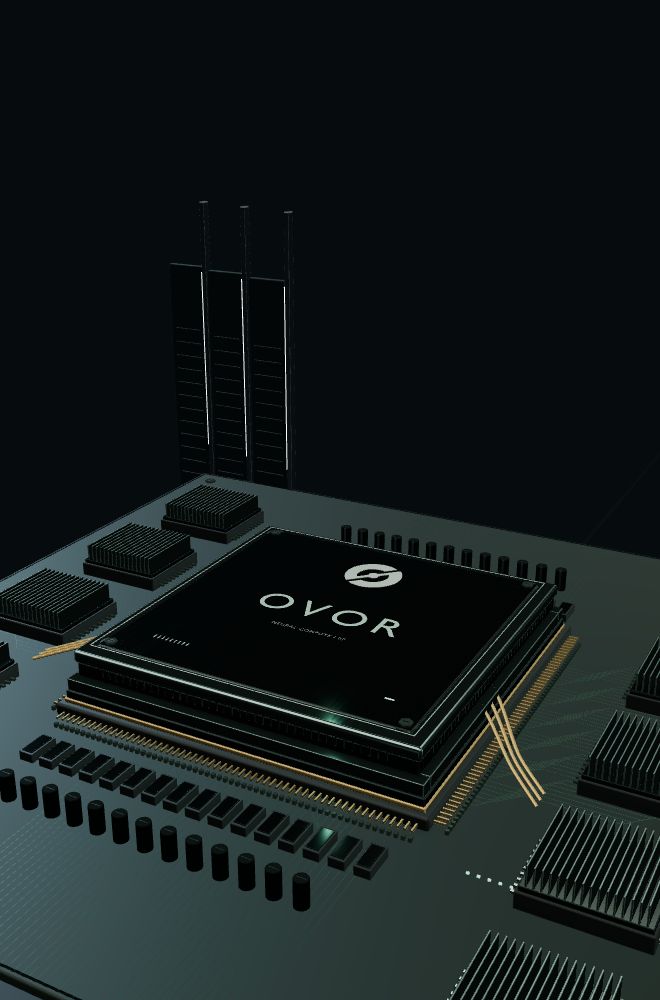
We build customAI models.
Your data. Your ambition.
A model engineered around it.
From-scratch training & fine-tuning.
Language · Image · Video · Audio · Multimodal.
Intelligencebegins with data.
We design the representations, architecture
and parameters behind your model.
Represent the input as tokens or latent features.
Trainthe intelligence.
A forward pass. A measured error.
Weights that change with learning.
Curated data defines what the model can learn.
Test whatit can do.
Measure quality, robustness and efficiency.
Then optimize and serve.
Evaluate task quality on held-out data.
ILLUSTRATIVE MODEL DEVELOPMENT PROCESSLanguage, generated.
One checkpoint. A new capability.
Context becomes a sequence of predicted tokens.
ILLUSTRATIVE OUTPUT · NOT AN OVOR MODEL RESULTYour model.Engineered by Ovor.
Model. Evaluation. Inference. Handover.
A new model. A new capability.
Built around your direction.
Choose the capability.
We engineer the model.
Five model families. From the first training run to an evaluated model you can build on.
Language models.
Built for your domain.
Develop custom LLMs for the language, knowledge and reasoning capabilities your model needs. From architecture and pretraining to domain adaptation and post-training.
- From-scratch language model training
- Domain & instruction fine-tuning
- Evaluation, alignment & inference
Inside the architecture
 LANGUAGE MODELArchitecturePretrainingPost-training
Define the target vocabulary, context length, domain behaviour and evaluation tasks before choosing the architecture and training strategy.
Build from the foundations.
Or advance what already exists.
A model of your own.
Define architecture, curate the dataset and learn the model parameters from initialization.
A focused adaptation.
Adapt a pretrained checkpoint. Update base-model weights for your target task and domain.
Learn with adapters.
Freeze the base model and train low-rank adapters. Scope the method around the target capability.
From-scratch training and adaptation are different starting points. We choose the route around your data, compute, licensing and evaluation criteria. Instruction or preference training can refine the behavior where appropriate.
Beyond a model.
A complete handover.
A clear path from research to a model you can evaluate, operate and develop further.
Deliverables and ownership are defined in your project scope.YOUR MODEL / ENGINEERING PACKAGE- 01
Model specification
Target capability, architecture, data strategy and success criteria.
- 02
Training & checkpoints
Training or adaptation code, configuration and selected model artifacts.
- 03
Evaluation evidence
Held-out results, baseline comparisons and documented limitations.
- 04
Inference & documentation
Serving setup, operating guidance and the agreed deployment plan.
From dataset.
To deployed model.
Define the capability. Choose the architecture and objective. Measure what the model actually learns.
01Define. Curate.
+
Set the target capability, modality and evaluation criteria. Audit data rights, quality, coverage and train/validation splits.
THE OUTPUT / Model specification and data strategy02Architect. Train.
+
Choose from-scratch training or adaptation. Define representations, architecture, objectives and the compute plan; train and track checkpoints.
THE OUTPUT / Training pipeline and model checkpoints03Evaluate. Refine.
+
Evaluate on held-out tasks, inspect failure modes and compare against the baseline. Refine through fine-tuning or post-training where appropriate.
THE OUTPUT / Evaluation report and selected checkpoint04Optimize. Serve.
+
Profile latency and memory. Select serving, quantization or distillation approaches where appropriate, then package and monitor inference.
THE OUTPUT / Inference package and deployment planModel questions.
Clear answers.
From scratch or fine-tuning?
Both are part of our scope. The choice depends on how different the target capability is, the available data and compute, base-model licensing and the level of control you need.
Which model families do you develop?
Language, image generation, video generation, audio generation and multimodal models. The architecture, training objectives and evaluation plan are specific to each family.
What data and compute will we need?
Requirements depend on model scale, modality, quality targets and the training route. Discovery establishes data readiness, usage rights and a realistic compute plan before a training run is scoped.
How do you define a successful model?
We agree on task-specific quality, robustness and efficiency criteria. Evaluation uses held-out data and relevant baselines, with limitations documented alongside the results.
What does the handover include?
The proposal defines the model artifacts, training or adaptation code, evaluation results, documentation and inference setup. Ownership and usage rights depend on the agreed scope and any base-model or dataset licenses.
Let’s develop
your model.
Your target capability.
Your data and direction.
Our model engineering.